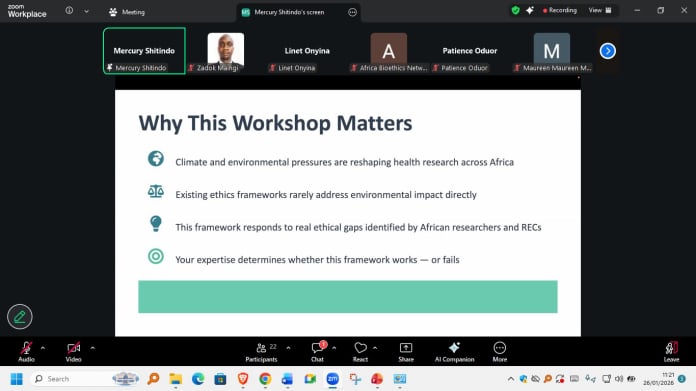
In January 2026, the Africa Bioethics Network convened approximately 100 stakeholders across six continental validation workshops to critically review and refine the Ethical Integration Framework for Environmentally Sustainable Health Research in Africa.
This work is part of an ongoing initiative supported by the World Health Organization (WHO), exploring the ethical dimensions of climate- and environment-affected health research across diverse African contexts.
The workshops focused on examining the framework’s:
- Clarity and coherence across varied research settings
- Practical usability for researchers and ethics committees
- Contextual relevance across diverse African research ecosystems
- Adaptability across regions, languages, and institutional capacities
- Participants worked together to review, challenge, and strengthen the framework.
The sessions brought together approximately 100 stakeholders from across the continent, including:
- Health researchers and scientists
- Research Ethics Committee (REC) members
- Policymakers and institutional leaders
- Cross-sector partners working at the intersection of climate, environment, and health
Their diverse perspectives were central to ensuring the framework reflects the realities of research conducted across Africa's varied environmental, institutional, and governance contexts.
Continental Validation at a Glance
By the Numbers:
~6 workshops across 5 regions over 4 days
~100 participants from across Africa
~18 ethical principles critically reviewed
~3 implementation tools tested against real scenarios
~3 languages: English, French, Arabic
~100% regional coverage: East, West, Central, Southern, North Africa
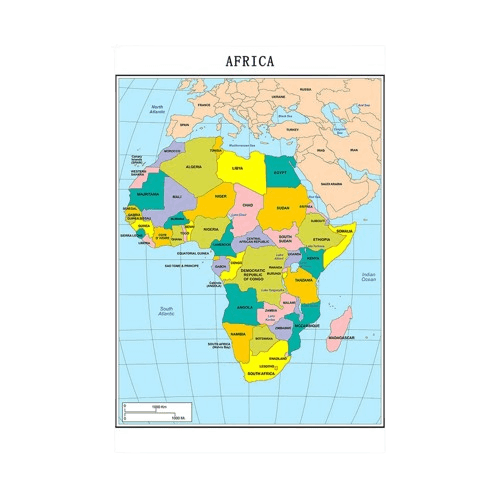
Over four days, six workshops were held across five African regions in English, French, and Arabic, ensuring broad geographic and linguistic representation.
West Africa - Monday, 26 January 2026 | English (09:00-13:30 WAT) and French (14:00-18:30 WAT)
West African participants explored the framework's principles and tools, focusing on clarity, coherence, and practical application. Discussions highlighted the importance of regional linguistic adaptations and the integration of francophone perspectives in ethical guidance.
East Africa - Tuesday, 27 January 2026 | English (09:00-13:30 EAT)
East African stakeholders tested the framework against real research scenarios, examining feasibility in resource-limited and climate-affected settings. Particular focus was given to community engagement in climate-vulnerable populations and data governance challenges.
Southern Africa - Wednesday, 28 January 2026 | English (09:00-13:30 SAST)
Southern African discussions emphasized institutional capacity, governance structures, and contextual adaptation. Participants examined how the framework aligns with existing regulatory frameworks and research governance systems.
Central Africa - Thursday, 29 January 2026 | French (09:00-13:30 WAT)
Central African participants provided critical French-language perspectives, ensuring linguistic accessibility and regional relevance. The session strengthened considerations around cross-border environmental health research and regional collaboration.
North Africa - Thursday, 29 January 2026 | Arabic, French and English (10:00-14:30 EET)
North Africa's multilingual session highlighted equity, community engagement, and intergenerational justice as foundational ethical considerations. Participants integrated Arabic-context perspectives and North African environmental health priorities.
Together, these sessions generated rich, detailed insights that will shape the next phase of the framework.
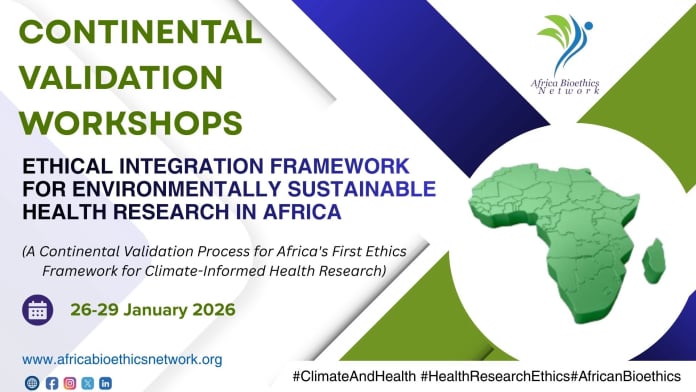
The Ethical Integration Framework for Environmentally Sustainable Health Research in Africa supports ethical decision-making for health research conducted under climate and environmental pressures.
Structure:
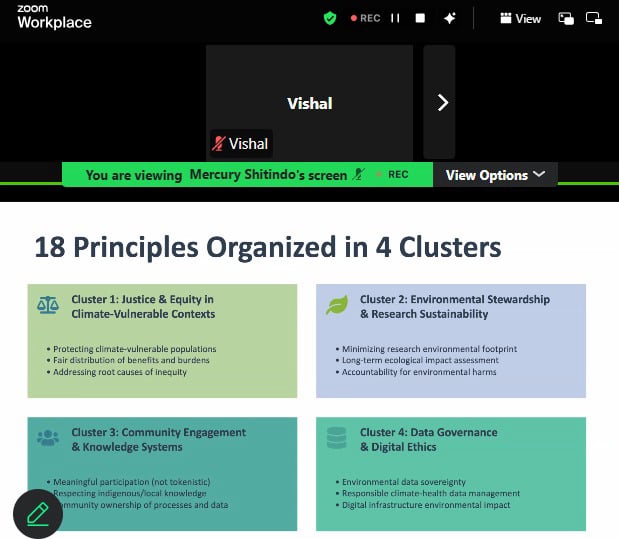
18 ethical principles organized in four thematic clusters
3 practical implementation tools for researchers and Research Ethics Committees
Regional adaptation guidance for diverse African contexts
The framework addresses challenges including:
✅ Climate-sensitive diseases and environmental health risks
✅ Research in environmentally stressed and climate-vulnerable settings
✅ Data-driven and technology-enabled health research with environmental footprints
✅ Community-engaged and cross-sectoral research in climate-affected contexts
✅ Planetary health, equity, and intergenerational justice
✅African relational ethics (Ubuntu, Harambee, communalism) integration
The framework is intended as a practical resource for researchers, ethics committees, institutions, and policymakers working where climate, environment, and health intersect.
Across the six workshops, participants:
✅ Critically tested the framework's relevance and clarity for diverse African research contexts
✅ Applied ethical tools to real-world research scenarios, identifying strengths and implementation gaps
✅ Provided detailed written feedback on each principle and tool through structured validation forms
✅ Identified areas requiring clarification, strengthening, and regional adaptation
✅ Highlighted linguistic considerations for English, French, and Arabic contexts
✅ Surfaced practical tensions between ideal ethical principles and implementation realities in resource-constrained settings
Insights from the workshops will directly shape Framework Version 2.0.
Once finalized, the validated framework will serve:
→ Research Ethics Committees reviewing climate-health research protocols
→ Researchers designing environmentally sustainable health studies
→ Institutional review boards across African universities and research institutes
→ Funding agencies setting ethical standards for climate-health research grants
→ Policymakers developing research governance guidelines
→ Continental bodies shaping African research ethics standards
The workshops represent a critical milestone in developing continent-wide ethical guidance for climate-health research.
Next Steps:
February-March 2026:
Systematic analysis of all validation feedback
Organize and code participant input
Conduct regional comparison analysis
Write synthesis memos for each principle and tool
March 2026:
Framework revision based on regional input
Revision meeting with regional representatives
Document all decisions and rationale
Draft Framework Version 2.0
April 2026:
Broader public consultation
Share revised framework with continental stakeholder community
Two-week consultation period
Incorporate final feedback
Mid-2026 (anticipated):
Publication and continental dissemination
Publish final Framework Version 2.0
Release comprehensive validation report
Distribute policy briefs for different audiences
2026-2027:
Training and implementation support
Develop training materials
Conduct webinars and workshops
Support RECs and researchers in framework adoption
This collaborative approach ensures the framework is grounded in African research realities and responsive to diverse institutional, environmental, and governance contexts.
Acknowledgement
The Africa Bioethics Network extends deep gratitude to the approximately 100 participants who brought their expertise, critical perspectives, and commitment to these intensive regional validation sessions. Your willingness to question, challenge, and refine has been essential to ensuring this framework will be both rigorous and practical.
Special thanks to:
→ Research Ethics Committee members who tested tools against real-world implementation challenges
→ Researchers who brought practical scenarios and honest feedback about feasibility
→ Policymakers who provided institutional and governance perspectives
→ Regional facilitators who navigated complex discussions across languages, contexts, and time zones
→ The ABN Secretariat team for meticulous coordination across five continental regions
→ The World Health Organization for supporting this critical continental effort
Your contributions are shaping a resource that will guide ethical health research across Africa for years to come. This is truly a framework built together.
For updates on Framework Version 2.0:
Visit: ABN website
Email: climate.ethics@africabioethicsnetwork.org
Follow the conversation:
#ClimateAndHealth #HealthResearchEthics #AfricanBioethics #EnvironmentalJustice #ResearchEthics #ClimateJustice #PlanetaryHealth #SustainableResearch #AfricaLeads
Africa Bioethics Network
Leading Continental Dialogue on Health Research Ethics
January 2026